Golden Triangle Composition: A Practical Guide for Photographers
How the golden triangle composition rule works, why diagonals feel dynamic, and how to use it for landscape, street, architecture and portraits.

Sharif Khaleel
· 3 min read
If the rule of thirds is about stability and the golden spiral is about flow, the golden triangle is about energy. It is the guide to reach for when your scene is full of strong diagonal lines.
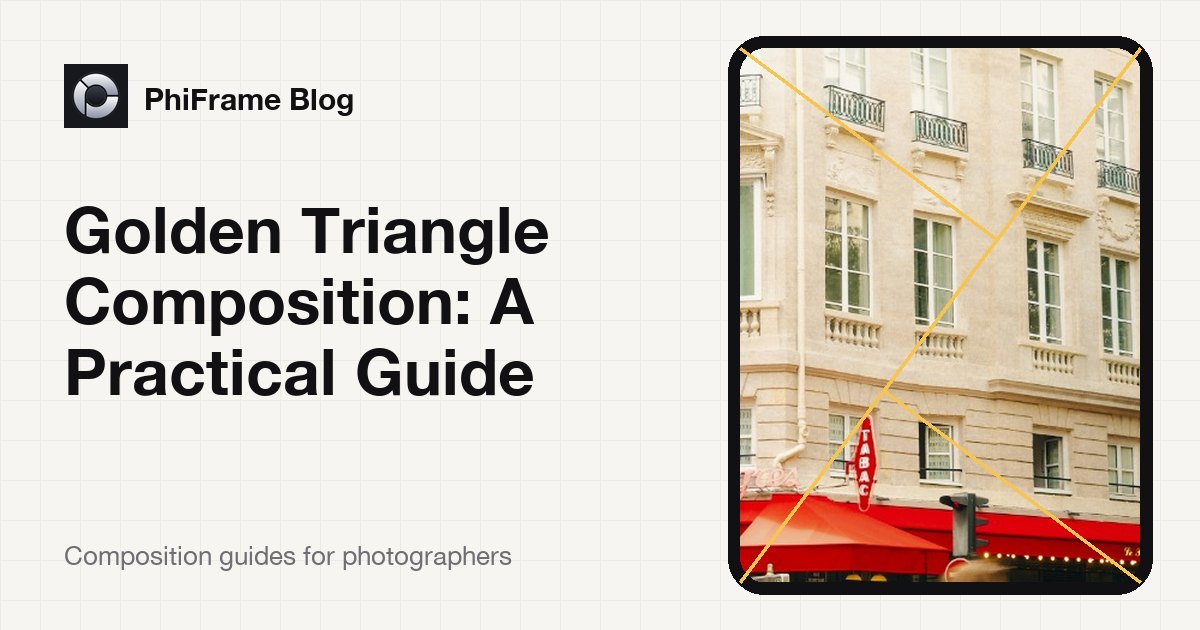
How golden triangles are built
- Draw a diagonal from one corner of the frame to the opposite corner.
- From each of the two remaining corners, draw a line that meets the diagonal at a right angle.
That gives you four triangles: two large and two small. The two points where the shorter lines meet the main diagonal are the strongest positions in the frame, much like the intersections on a thirds grid.
The shape of the triangles depends on the aspect ratio. In a wide 16:9 frame they are long and thin, while in a square 1:1 frame the two short lines meet the diagonal at the same point in the centre. Always judge the triangles in the aspect ratio you will actually shoot.
Why diagonals feel dynamic
Horizontal lines suggest rest, like the horizon or a person lying down. Vertical lines suggest strength and stillness, like trees, columns or a person standing. Diagonals suggest movement: a slope, a fall, a road disappearing into the distance.
Golden triangles give you a structure for those diagonals, so the photo feels energetic without feeling chaotic.
How to use golden triangles
Align strong diagonals with the main line
Rooftops, staircases, shorelines, bridges, mountain ridges and shadows all make natural diagonals. Line the most important one up with the main diagonal of the guide.
Place subjects where the lines meet
Put your main subject at one of the two intersections, where a short line meets the diagonal. It will sit in a position that feels deliberate and balanced against the diagonal.
Fill triangles with contrasting content
Use the triangles as zones: sky in one, land in another; a lit wall against a shadowed one; a busy street against an empty pavement. Contrast between the zones strengthens the diagonal.
Pair it with the right orientation
The main diagonal can run either way: bottom-left to top-right, which reads as rising for left-to-right readers, or top-left to bottom-right, which reads as falling or descending. Choose the direction that matches the mood you want.
Where golden triangles shine
- Architecture: shoot buildings from below and let converging edges follow the triangles.
- Landscapes: a mountain ridge or a shoreline running corner to corner.
- Street photography: long shadows and crossings, or a subject walking along a diagonal kerb.
- Sport and action: limbs, bats, rackets and bodies in motion naturally form diagonals.
- Portraits: a tilted head or a leaning pose along the diagonal, with the eyes at an intersection.
Practise with the guide on screen
Diagonal compositions are hard to judge by eye, because a few degrees can make the difference between deliberate and accidental. PhiFrame draws golden triangles live on your iPhone viewfinder, whether you shoot in 4:3, 16:9 or 1:1. It also has a precision horizon level with haptic lock for the moments you want everything perfectly straight instead.