10 Photography Composition Rules Every Photographer Should Know
The classic photography composition rules explained: rule of thirds, golden ratio, Fibonacci spiral, golden triangles, leading lines and more.

Sharif Khaleel
· 4 min read
Two photographers can stand in the same spot, point at the same scene, and come home with completely different pictures. The difference is almost always composition: where things sit in the frame, what the eye notices first, and where it travels next.
Composition "rules" aren't laws. They are patterns that painters, architects and photographers have noticed over centuries because they reliably produce images that feel balanced, calm, dynamic or dramatic. Learn them, practise them until they become instinct, and then break them on purpose.
Here are ten composition rules worth knowing, from the most familiar to the more advanced.
1. Rule of thirds
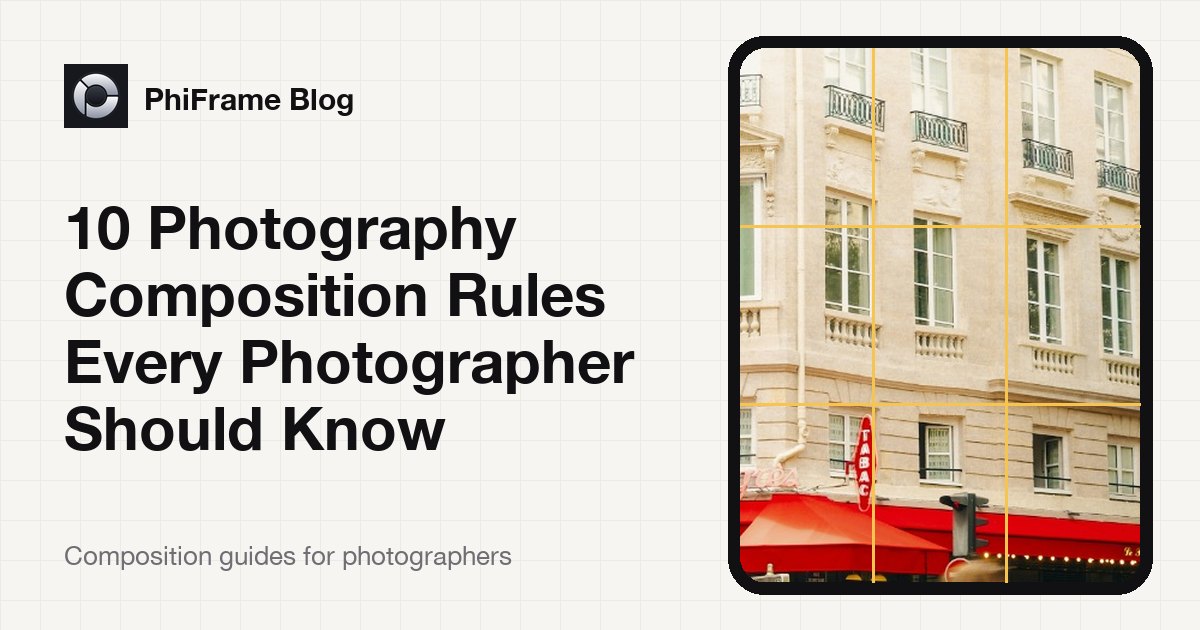
Divide the frame into a 3×3 grid with two vertical and two horizontal lines. Place your subject on one of the lines, or where two lines cross, rather than in the dead centre.
Why it works: an off-centre subject creates tension and leaves space for the scene around it. Placing the horizon on the upper or lower third, instead of across the middle, instantly makes a landscape feel more intentional.
Try it with: landscapes, portraits, street scenes. It is the most versatile starting point.
2. Golden ratio (phi grid)
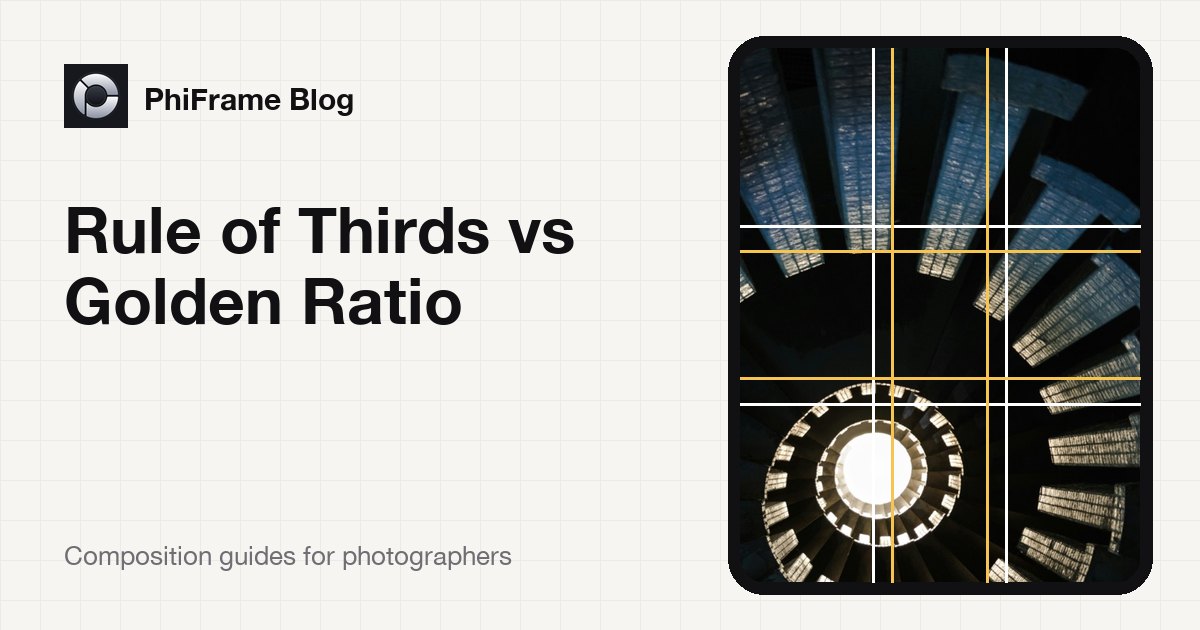
The phi grid looks like the rule of thirds, but its lines sit at the golden ratio, roughly 38% and 62% of the frame (a ratio of 1 : 1.618), so the intersections are closer to the centre.
Why it works: the golden ratio appears throughout classical art and architecture. Subjects placed on the phi grid feel balanced without looking deliberately off-centre.
Read more: Rule of thirds vs golden ratio.
3. Fibonacci (golden) spiral
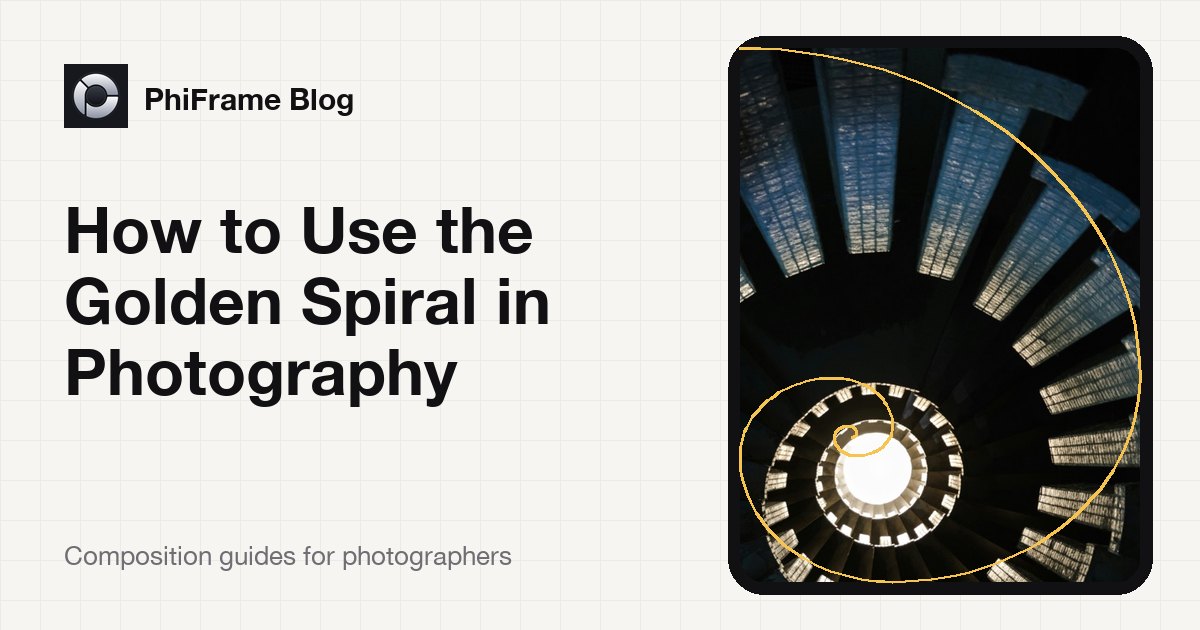
The golden spiral is built from a sequence of squares sized by the golden ratio, with a quarter-circle drawn through each. It sweeps around the frame and tightens towards a single point.
Why it works: the eye follows curves. Put your main subject at the tight end of the spiral and let curving lines in the scene, such as a staircase, a shell, a coastline or the curve of a shoulder, follow the sweep.
Read more: How to use the golden spiral in photography.
4. Golden triangles
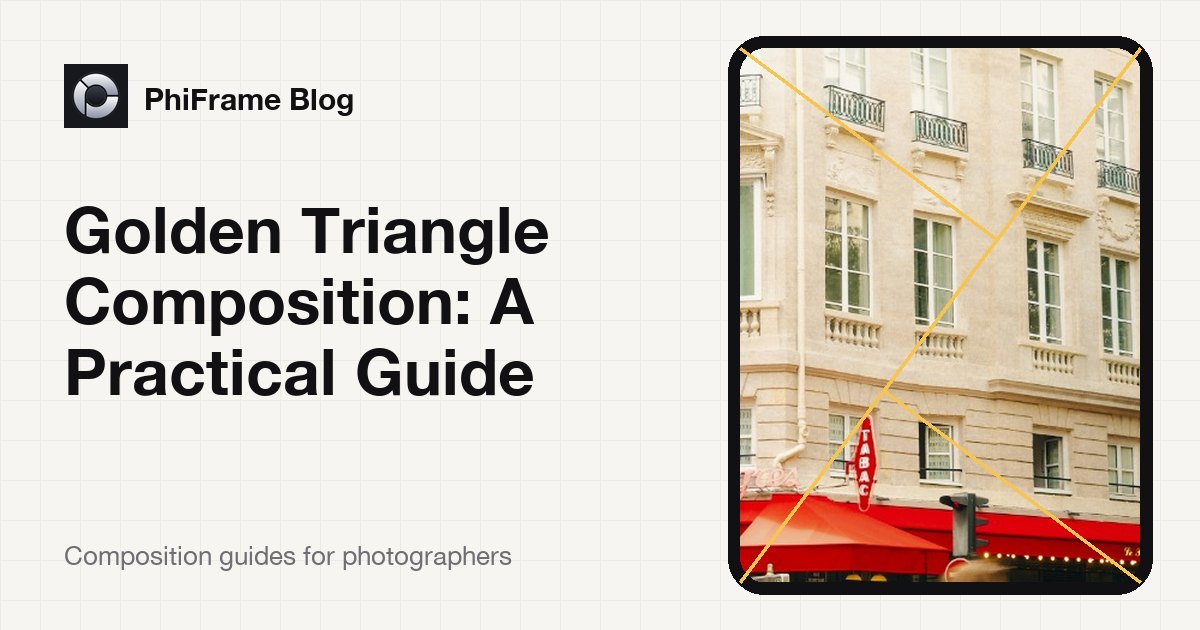
Draw a diagonal from one corner to the opposite corner, then draw lines from the two remaining corners that meet the diagonal at right angles. You get four triangles.
Why it works: diagonals feel dynamic. Golden triangles help you arrange strong diagonal lines and place subjects where the lines meet.
Read more: Golden triangle composition explained.
5. Diagonals
Diagonal lines at 45° from each corner (sometimes called the baroque and sinister diagonals) give a frame energy and movement. Horizontal and vertical lines feel stable; diagonals feel like something is happening.
Try it with: architecture, sport, staircases, roads and rooftops.
6. Leading lines and the vanishing point
Roads, rails, corridors, fences and rivers can all lead the eye through the photo. When parallel lines converge on a vanishing point, the effect is strongest. Place that point deliberately, often on a thirds or phi intersection, and everything in the frame points to it.
7. Symmetry and centred composition
Not every subject belongs off-centre. Reflections, doorways, bridges and formal architecture often look most powerful when perfectly centred and symmetrical. The key is precision: a symmetrical shot that is slightly off looks like a mistake.
8. Level horizons
A tilted horizon is one of the most common reasons a photo feels "off". Unless the tilt is clearly deliberate, keep horizons perfectly level, especially over water where any tilt is obvious.
9. Negative space
Empty sky, a plain wall or calm water around a small subject can make it feel isolated, peaceful or dramatic. Negative space works best combined with another rule: a tiny subject on a thirds intersection with open space around it is a classic minimalist composition.
10. Fill the frame
The opposite of negative space: get closer (or zoom in) until your subject fills the frame. This removes distractions and reveals texture and detail you would otherwise miss.
How to actually learn composition
Reading about composition helps, but the fastest way to learn is to see the guides while you shoot. When the grid, spiral or triangle is drawn over the scene in front of you, you start noticing where lines fall, where the horizon sits, and where the subject wants to go.
That is exactly why we built PhiFrame. It is a composition camera for iPhone that draws the rule of thirds, golden ratio phi grid, Fibonacci spiral, golden triangles, diagonals and a draggable vanishing point live on your viewfinder, along with a precision horizon level with haptic lock. Switch between guides in an instant, keep photos clean or burn the guide in as a reference, and shoot full-quality photos including ProRAW.
Pick one rule this week and shoot nothing but that. Next week, pick another. Within a month you will start seeing the lines without the guide.